|
|
|

|
The Nieuwkapelle family
Remigius Beyen from Nieuwkapelle |
Petrus Jacobus Beyen and his family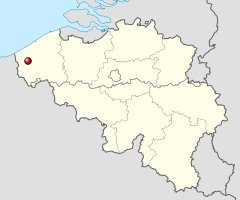 Nieuwkapelle is a town in the Belgian province of West Flanders, near Diksmuide and Veurne. Nowadays it is a part of the municipality of Diksmuide. The map shows the location of Nieuwkapelle in Belgium. Nieuwkapelle is a town in the Belgian province of West Flanders, near Diksmuide and Veurne. Nowadays it is a part of the municipality of Diksmuide. The map shows the location of Nieuwkapelle in Belgium.
In the past, Belgium was called the Southern Netherlands. It was governed for many years by the Spanish and the Austrians. On April 20, 1698 a certain Petrus Jacobus Beyen (1.1) married Jacoba Stoet in Nieuwkapelle. Petrus (also called Pieter) and Jacoba had no less than nine children. On September 30, 1717 their youngest child, Remigius (2.1), was born. He was baptized on October 1. His first name is most likely derived from Saint Remigius of Reims, whose feast is celebrated on October 1 as well.
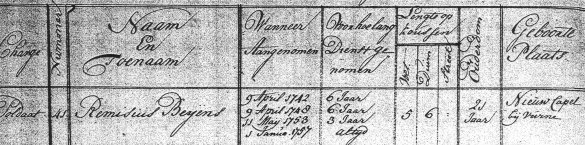
Six of Pieter's thirteen children died in infancy. Some of his other children had many offspring. Many Belgians who have the name Beyen descend from them. A separate page deals with the surname Beyen in Belgium. Remigius moved to the (Northern) Netherlands and had many descendants there. He is the ancestor of what is called on this site the Nieuwkapelle family. Remigius Beyen in the Dutch armyIn 1741 the Southern Netherlands got involved in the War of the Austrian Succession. France, Prussia and Spain were opposed to Austria, England and the Dutch Republic. Since 1713 the Dutch Republic had garrisons in a number of "barrier towns" in the Southern Netherlands along the French border as a protection against possible attacks from France. Veurne was one of these barrier towns.When the war began the garrisons had to be reinforced. On April 9, 1742 Remigius Beyen joined a Dutch regiment in Veurne.
In 1748 the war ended with the Treaty of Aix-la-Chapelle. Remigius continued to serve in the Dutch army. The regiment in which he served was stationed in many different garrison towns in the (Northern) Netherlands. It was only in 1779, after a period of service of as many as 37 years, that Remigius retired and received his pension.
During his military career, Remigius had founded a family in Nijmegen. The next page gives more details. |
|
The next page The homepage |
The overview of the site The top of the page |
Searching this website Comments or questions |