|
|
|

|
The Jan Thomas branch of the IJsselstein family
The tombstone of Gerrit Beijen |
 One of those graves that are situated behind the Dutch Reformed church in Bodegraven has a tombstone with a striking text. The translation is: One of those graves that are situated behind the Dutch Reformed church in Bodegraven has a tombstone with a striking text. The translation is:
GERRIT BEIJEN GERRIT'S SON
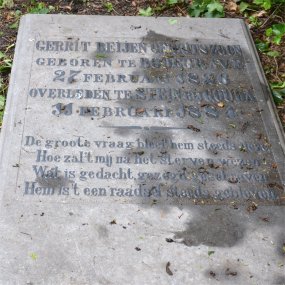
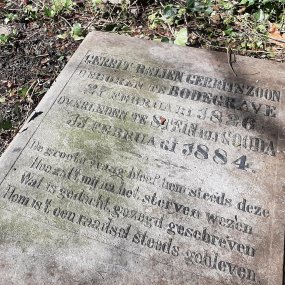
BORN IN BODEGRAVEN FEBRUARY 27, 1826 DECEASED IN STEIN NEAR GOUDA FEBRUARY 11, 1884 The great question for him was always this How will it be for me after death What has been thought, said, written It always remained a mystery for him Gerrit Beijen (11.21), who has been buried here, was a son of Gerrit Beijen (10.9) and a grandson of Jan Thomas Beijen (9.2), the central character of the Jan Thomas branch. Gerrit was a rich farmer, who remained a bachelor during his whole life. His philosophical streak is shown by the many poems that he has left. Some of the poems can still be found on the walls in the farm in Stein near Gouda where he has lived. Other poems are kept by family members. In 1881 Gerrit made his will in which he laid down in great detail what should be done after his death. One of his desires was to be buried in Bodegraven, the town where he was born. He described exactly the text that had to be put on his tombstone.
After Gerrit's death in 1884 the local council of Bodegraven accepted the bequest and the accompanying conditions. The distribution of foods to poor families continued till about 1967. After that year the money was added to the budget for the yearly day out of the elderly inhabitants of Bodegraven.
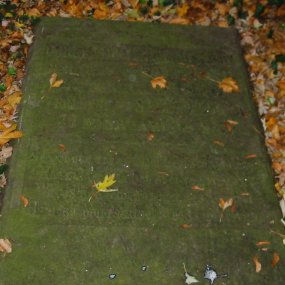
However, in later years the condition of the tombstone has declined again. The photo on the left, that was made in November 2011, shows that the tombstone was very dirty by then. Once again the text was hardly legible. After a new request to the municipality the stone was cleaned and the letters were painted black. The photo on the right, that was made on a rainy day in June 2012, shows that the text was then well legible again.
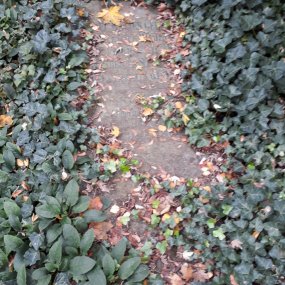
However, maintenance is still necessary. The photo above on the left, taken in October 2019, shows that the tombstone was largely overgrown at that time. After that, maintenance was performed a few times. The photo on the right was taken in April 2023 after a major renovation of the old cemetery that was carried out at the insistence of the 'Stichting Historische Kring Bodegraven' (thanks to Leendert Spijker from Bodegraven for the signals). |
|
The next page The homepage |
The overview of the site The top of the page |
Searching this website Comments or questions |