|
|
|

|
The Hengelo family
A ground Bijen near Weerselo |
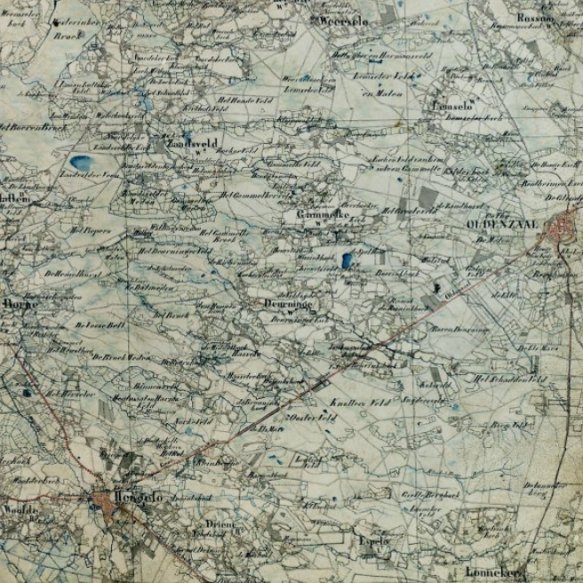
The map below shows the surroundings of Hengelo in Twente (the eastern part of the province of Overijssel) in the years 1830-1850. In that time Hengelo was a rural town, and it had no more than a few thousand inhabitants. Other places and hamlets that play a role on this page and the next two pages are Weerselo (at the top), Woolde (west of Hengelo), Deurningen (in the middle), Rossum (top right) and Hasselo (southwest of Deurningen, hardly visible). The origin of the Hengelo family Beijen laid in this area.
Family names and names of groundsIn the seventeenth and eighteenth centuries, family names were not yet established in the eastern parts of the Netherlands. Usually they were taken from the name of the 'erve' (ground) where someone lived. An erve was a farm with adjacent land and often some other buildings. The link to the farm name meant that after a move people were sometimes referred to by a different name. When a husband had moved into his wife's parental home after his marriage, both he and the children were often given the wife's house name.Changing family names makes genealogical research in these parts of the country more complicated. The erve BijenThe name of the Hengelo family Beijen comes most probably from the name of a former ground named Bijen near Weerselo, northeast of Hengelo.The erve Bijen was first mentioned in a tax register from 1601 and 1602 that was compiled under orders of the Overijssel authorities. Nothing can be said with certainty about the background of the name Bijen. In Dutch the word 'bijen' means 'bees', but the assumption that the name has something to do with these useful insects is probably too speculative. In later texts the name was also written as Bien or Biën. It was probably pronounced like the 3rd and 4th word in the English sentence "I will be an engineer". The census of 1748In August 1748, all inhabitants of Overijssel were registered by order of the regional government. The data was intended for a new tax system that has never been introduced.Two families with the name Bien were noted in Weerselo. The fact that they were listed one after the other indicates that they were neighbours. However, the baptismal, marriage and burial registers show little or no interrelationships, for example through baptismal witnesses, between these families. Therefore they probably were not related. They can have derived their names separately from living on the erve Bijen or Bien. For both families the Dutch word "slegt" was added. That means that they were poorly off. The Twente family BijenThe residents of one of the two houses were Herm Bien and his wife Geertke. At the time of the census, Herm and Geertke had no children, but four months later, in December 1748, a son was baptized. Herm was already deceased by then. Geertke probably moved or died shortly after the baptism of her child.From 1749 or 1750 the couple Berent Bijen and Geertjen olde Hofstede lived in that house. Berent was also called Bijenhuis (which means Bijen house). He probably bore this name only after the move. Berent and Geertjen had six children in the years 1750-1764: at first five daughters and finally a son. In 1797 that son, Albert Bijen, married Geertrui Kolbrink, who also was born in Weerselo. They had eleven children. All or almost all residents of Twenthe with the name Bijen are offspring of this couple. The Bijen family is not discussed further on this website. Jan Bien and his wife Greete or GeseAccording to the census the residents of the other house were Jan Bien, his wife Gese and their two young children Herm and Willem. This family is discussed on the next page |
|
The next page The homepage |
The overview of the site The top of the page |
Searching this website Comments or questions |