| The Beijen/Beyen Family Site by Laurens Beijen |
 |
|
The homepage The overview of the site The next page The previous page |
The list of first names The photo gallery Searching this website Comments or questions |
The Johan Franco branch of the IJsselstein family
Hendrik Rudolph Beijen Senior
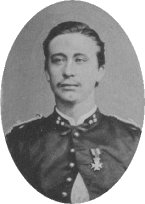 Hendrik Rudolph Beijen (11.9) was born in Barneveld in 1843. He was the third son of the physician Johan Franco (IV) Beijen, one of the main characters on the page The Johan Franco's IV, V and VI, to reach adulthood. His family nickname is unknown; throughout this page I simply refer to him as Hendrik. Like his elder brothers Johan Franco (V) and Pieter, he chose a military career. Trained for service in the Dutch East IndiesIn 1859 Hendrik entered the Royal Military Academy in Breda as a cadet, where he trained for service with the infantry in the Dutch East Indies. After completing his studies in 1863 he was commissioned as a Second Lieutenant. In October of that year he sailed from Nieuwediep, near Den Helder, for Batavia, arriving there in February 1864. The Suez Canal had not yet been opened, so the voyage took several months.Service on several islandsDuring his first years in the Dutch East Indies Hendrik served in southern Sumatra, the Moluccas and Java. He was promoted to First Lieutenant in 1870. The following year he became adjutant to the staff of a military command on Java, and in 1873 he successively served with two infantry battalions.Seriously wounded in AcehIn 1873 war broke out between the Netherlands and the independent Sultanate of Aceh in northern Sumatra. The Dutch government cited piracy in the Strait of Malacca as its principal reason for military intervention. The conflict eventually lasted for more than thirty years.The first Dutch expedition to Aceh in April 1873 ended unsuccessfully. A second and much larger expedition followed in October of that year. Hendrik was appointed adjutant to the commander of one of the infantry brigades. During fighting near Kota Radja (present-day Banda Aceh) on 16 April 1874, Hendrik was shot several times in his right leg. His injuries proved so severe that his lower right leg had to be amputated. Afterwards, a committee of the Netherlands Indies Red Cross presented him with an artificial leg, then an expensive and far from commonplace medical aid. Contrary to the original plan, however, Hendrik never travelled to the Netherlands on leave; the artificial limb was fitted in the Dutch East Indies. The Military Order of WilliamIn October 1874 many participants in the Aceh expedition received royal decorations. Hendrik was awarded the Military Order of William, the Netherlands' highest military decoration for bravery.Continuing his military careerDespite his severe disability, Hendrik remained on active duty. He first returned to infantry service on Java. In September 1875 he was promoted to Captain, and later that year he was transferred to Aceh as deputy chief of the military staff. In 1877 he became military commander of the island of Ternate in the Moluccas.In 1883 he was honourably discharged from military service at his own request on medical grounds. After his retirement Hendrik did not return to the Netherlands. Instead he settled in Soekaboemi (present-day Sukabumi) in West Java, where he served for many years as administrator of a military sanatorium. Newspaper reports in 1897 announced that he intended to resign and travel to the Netherlands to recover his health, but no evidence has been found that he ever made the journey. Two marriagesShortly after his retirement, in 1884, Hendrik married Anna Johanna Regina Stops, who had been born on Ambon in 1846. She was the mother of Piet Beijen, mentioned below. At the time of their marriage Hendrik formally acknowledged Piet as his son. Anna died in 1911.In 1913 Hendrik married Maria Constantia Vollprecht, who had been born in Palembang in 1866. Hendrik's childrenReconstructing family relationships in the former Dutch East Indies is often difficult. Civil registration existed only for the European population and those legally placed in the same category, and many of those records have been lost. Genealogical research is further complicated by the fact that many children were born from relationships between European men and Indigenous women that were never officially registered.As far as is known, Hendrik had three sons, in addition to a daughter or foster daughter about whom little is known. Each of his sons has a separate page on this website: Died in 1922Hendrik died in Soekaboemi in January 1922 at the age of seventy-eight. He had spent almost his entire adult life in the Dutch East Indies and had lived for nearly forty-eight years after losing his lower right leg. He was buried in the former European cemetery of Soekaboemi on Kerkhofweg. |
|
The next page The homepage The overview of the site |
The top of the page Searching this website Comments or questions |