|
|
|

|
The Johan Franco branch of the IJsselstein family
Johan Beijen and Mechteld van Meerland |
Officer in the NavyJohannes Beijen (6.21), who used to be called Johan or Jan, was born in IJsselstein in 1672. He was one of the sons from the fourth marriage of the 'chirurgijn' Dirck Beijen (5.6), the subject of the page Dirck Gijsbertsz. Beijen and his wives.Johannes (Johan) was the link between the oldest generations and the Johan Franco branch. Therefore he can also be found in generation 6 of the overview of the Johan Franco branch. We don't know anything about Johan's childhood. Later documents show that he must have been educated to become a naval officer. As IJsselstein did not have a seaport, it was for an IJsselstein boy not an obvious choice of career to apply for the Navy. Probably Johan was inspired by his uncle Pieter van Laren, a brother of his mother, who was a naval captain at the Admiralty of Amsterdam. The Admiralty was one of the independent branches of the Navy of the Dutch Republic. Mechteld and her father Franco van MeerlandIn or shortly before 1704, when Johan was already nearly 32 years old, he went steady with Mechteld van Meerland, the daughter of the IJsselstein burgomaster Franco van Meerland.Franco van Meerland belonged to one of the prominent families of IJsselstein. During his long life (he reached the age of 92) he held positions in the IJsselstein city council for almost 50 years. Besides, he was very rich. Mechteld was his only daughter. Therefore we can assume that many young men in the IJsselstein area were interested in her. Objections to the marriageIn 1705 Johan and Mechteld wanted to marry, but Mechteld's father had serious objections. Maybe he did not consider Johan as a suitable match for his daughter. Mechteld's mother had passed away several years before.
The next day the church council decided to publish the banns. The wedding was not in IJsselstein but elsewhere: in the small town of Blauwkapel near Utrecht. One sonAfter their wedding Johan and Mechteld lived in Edam, a town north of Amsterdam that participated in the Admiralty. Johan's uncle Pieter van Laren lived in Edam as well.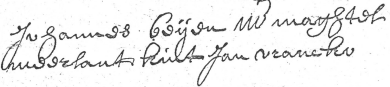 In 1706 they had a son Johan Franco (7.1). The names that were noted in the baptismal records were "Jan vrancko", but this spelling was never used again afterwards. Apparently the second given name of the child was a sign of reconciliation towards Mechteld's father. In 1706 they had a son Johan Franco (7.1). The names that were noted in the baptismal records were "Jan vrancko", but this spelling was never used again afterwards. Apparently the second given name of the child was a sign of reconciliation towards Mechteld's father.
An early end of the marriageJohan Beijen made a successful career in the Navy. In 1708 he was appointed commander, and in 1710 the Admiralty of Amsterdam gave him the command of the warship Ooststellingwerf with 250 crewmen.Johan died unexpectedly in 1712, only 39 years old. Mechteld and the young Johan Franco were left in Edam. In 1720 they moved to Dordrecht, where Mechteld married Willem Beijen. It was a coincidence that Willem had the same family name as Mechteld's first husband: he belonged to the Dordrecht family Beijen that later became extinct. It was also a coincidence that Willem, just as Johan, was a commander in the Navy. Mechteld, who was forty years old when she remarried, had no children from her second marriage. She died in 1734. Her son Johan Franco married in 1731 and moved to IJsselstein, where his ancestors had lived.
|
|
The next page The homepage |
The overview of the site The top of the page |
Searching this website Comments or questions |